
VF AGENCIA LITERARIA
Cecilia Eudave


Cecilia Eudave (Guadalajara, México). Narradora y ensayista. Profesora investigadora en la Universidad de Guadalajara, México, y miembro del Sistema Nacional de Investigadores (SNI) en su país. Cuenta con varios libros y artículos de investigación en el área de literatura mexicana e hispanoamericana, así como en estudios de la literatura fantástica e insólita. Destacamos en esta línea sus libros, Sobre lo fantástico mexicano, acreedor de una mención honorífica en el 13th Anual International Latino Book Awards en el marco de la BookExpo America, en Nueva York, Diferencias, alteridades e identidad (Narrativa mexicana de la primera mitad del siglo XX) Alicante, España.
En su faceta como escritora mencionemos: Registro de Imposibles (cuentos, 2000, 2006, 2014), Bestiaria vida (Novela, 2008, 2018), con la cual ganó el premio de novela Juan García Ponce; Técnicamente humanos y otras historias extraviadas (Cuentos, 2009), Para viajeros Improbables (minificción, 2011, 2021), En primera persona (cuentos, 2014), Aislados (novela, 2015), Microcolapsos (minificción, 2017, 2019). Entre sus últimas publicaciones está Al final del miedo (cuentos, 2021) publicado por Páginas de Espuma y la novela El verano de la serpiente publicada en el 2022 por Alfaguara. Escribe también cuentos infantiles con títulos como Papá Oso (2010) y Bobot (2018), y novela para jóvenes como La criatura del espejo (2007), El enigma de la esfera (2008), y Pesadillas al medio día (2010). En el 2025 publicó La belleza del fantasma (ensayo lírico) en la editorial Eolas, España.
Ha sido traducida a varios idiomas, participado en diversas antologías y revistas tanto en su país como en el extranjero. En el 2014 fue la escritora invitada de honor por el Ministerio de Cultura y el Instituto de Traducción Coreano, en 2016 se le otorgó la Cátedra América Latina por la Universidad Jean Jaurès en Toulouse, Francia, en el 2018 fue invitada de honor de la Cátedra Dolores Castro por la Universidad Autónoma de Aguascalientes. En el 2023 fue favorecida por el programa Francisco Giner de los Ríos para una estancia como profesora-escritora invitada en la Universidad Alcalá de Henares, España. Ha impartido numerosos talleres de escritura tanto en México como en el extranjero.
Cecilia Eudave (Guadalajara, Mexico). Narrator and essayist. Research professor at the Guadalajara University, Mexico, and member of the National Researchers System (SNI). She has written various books and research articles on Mexican and Latin American literature, as well as on studies of fantastic and unusual literature. In this line of books, Sobre lo fantástico mexicano received a honourable mention in the 13th Anual International Latino Book Awards at the BookExpo America in New York; and Diferencias, alteridades e identidad (Narrativa mexicana de la primera mitad del siglo XX) Alicante, España.
Her fiction works include Registro de Imposibles (Short stories, 2000, 2006, 2014), Bestiaria vida (Novel, 2008, 2018), with which she was awarded the Novel Award Juan García Ponce; Técnicamente humanos y otras historias extraviadas (Short stories, 2009), Para viajeros Improbables (minifiction, 2011, 2021), En primera persona (cuentos, 2014), Aislados (novela, 2015), Microcolapsos (minificción, 2017, 2019). Her latest publications are Al final del miedo (Short stories, 2021) published by Páginas de Espuma and the novel El verano de la serpiente published in 2022 by Alfaguara. She also writes children literature, including titles such as Papá Oso (2010) and Bobot (2018), and the young adult novels La criatura del espejo (2007), El enigma de la esfera (2008), and Pesadillas al medio día (2010). In 2025 she published La belleza del fantasma (lyrical essay) with Eolas, Spain.
Her works have been translated into many languages and included in anthologies and magazines in Mexico and abroad. In 2014, she was the writer guest of honour of the Secretary of Culture and the Korean Institute of Translation. In 2016 she was awarded the Cátedra América Latina by the Jean Jaurès University in Toulouse, France. In 2018 she was the guest of honour of the Cátedra Dolores Castro by the Universidad Autónoma de Aguascalientes. In 2023 she was awarded a residence by the Francisco Giner de los Ríos programme as professor-writer guest in the Alcalá de Henares University in Spain. She has taught numerous writing workshops in Mexico and abroad.
Obras publicadas/Published titles
El verano de la serpiente
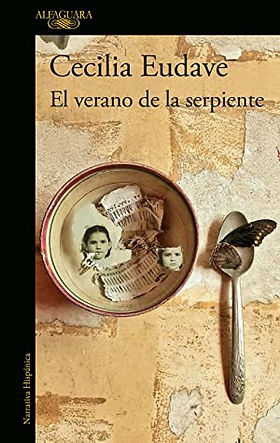
El verano de la serpiente es una historia magistralmente narrada desde perspectivas distintas que van confeccionando y perfilando a cada uno de los personajes. En sus páginas, asistimos al momento decisivo en la vida de una familia, durante el verano de 1977, que se desliza inquietante, develando los secretos que cada uno de ellos guarda.
En una feria ambulante, Maricarmen, la hermana mayor, pedirá conocer su futuro a una muchacha serpiente: la respuesta de esta será críptica y, por lo mismo, aterradora. A partir de ahí, sus vidas, y de quienes los rodean, irán zigzagueando entre una boa real que acecha el vecindario y una mujer fantasmal.
Una novela que danza entre la alegoría y la realidad, en la que Eudave nos lleva de la mano por la imaginación o las certezas de dos niñas que empiezan a descubrir el mundo, y se acercan a un momento decisivo y desconcertante que las llevará a cruzar el umbral de la infancia.
This novel is made of stories with different perspectives that make and shape each of the characters. We attend the decisive moment in the life of a family going through a summer that glides in an unsettling manner, revealing the secrets that each of them keeps. Secrets that confront them and force them to grow. To each chapter we add clues to complete an existential puzzle, where each one has his or her fraction of guilt and innocence. All taken from imagination of certainties of two girls who begin to discover the world from fantasy.
At a travelling fair, Maricarmen, the eldest of two sisters, has her fortune read by a serpent-woman; the resulting prophecy is both cryptic and frightening. From that point onwards, the sisters' lives, and the lives of those close to them, start circling around a real-life boa who lurks around their neighborhood, and the haunting apparition of a woman.
Al final del miedo

Con su narrativa inusual, Cecilia Eudave nos inquieta y perturba al tiempo que nos ubica, con estas historias llenas de extrañeza, en el umbral, en esa delgada línea que separa lo real de lo insólito.
¿Qué tienen en común un fotógrafo abordado por una joven diminuta en su computadora, una mujer que ha olvidado a las personas de su vida, un hombre anodino en busca de una historia extraordinaria, unos amigos que buscan un bar siniestro, un policía desesperado por resolver un brutal asesinato, unos mellizos acosados por una presencia escurridiza, un matrimonio que por accidente golpea un bulto con apariencia semihumana y un contador público que, con el fin de ligarse a una chica, se apropia de una profecía ancestral para explicar la aparición de los agujeros oscuros y profundos diseminados por la ciudad, por el planeta?
El lector decidirá, tras la lectura de este libro, de qué lado de la balanza quiere situarse y llegar como un personaje más al final de sus miedos.
What does photographer approached by a young woman on his computer, a woman who has forgotten the people in her life, a nondescript man searching for an extraordinary story, friends looking for a sinister bar, a policeman solving a brutal murder, twins harassed by an elusive presence, a married couple who accidentally hit a semi-human-looking bundle and a public accountant who, in order to hook up with a girl, appropriates an ancient prophecy to explain the appearance of the dark and deep holes scattered throughout the city, across the planet, have in common?
With her unusual narrative, Cecilia Eudave disturbs and makes the reader reach the end of his own fears as one more character, with stories full of strangeness, on the threshold, on that fine line that separates the real from the unusual, the reader has to decide on which side of the scale he wants to be positioned.
Bestiaria vida
%201.png)
En apariencia el mundo cercano, de casi cualquier familia, está poblado por gente común. ¿Qué sucede, entonces, cuando la protagonista de dicho universo descubre que su madre es una Basilisco; su padre, un Licántropo; su abuelo, un Cancerbero; su tío un Búfalo, y su hermana, una Súcubo? La respuesta se esconde en los laberintos de Bestiaria vida, la obra con la que Cecilia Eudave ganó el Premio Nacional de Novela Corta «Juan García Ponce», Bienal de Literatura de Yucatán 2006-07, y que, a la postre, hará que el lector levante la mirada y observe que todo lo que le rodea no es lo que parece.
In appearance the world of almost any family is populated by common people. What happens then, when the protagonist of this universe discovers that his mother is a Basilisk; his father, a Lycanthrope; his grandfather, a Hellhound; his uncle a Buffalo, and his sister, a Succubus? The answer hides in the labyrinths of Bestiaria vida, the work with which Cecilia Eudave won the National Short Fiction Prize "Juan García Ponce", Biennial of Literature of Yucatan 2006-07, and which, in the end, will make the reader look up and notice that everything around you is not what it seems.
Aislados

Tras un descuido al enviar mensajes por su celular, Pedro extravía a su madre en un abrir y cerrar de ojos. Sería un accidente si tan sólo Laura no estuviera "enferma de olvido" y necesitará el cuidado de todos. Sería una anécdota más a no ser porque a partir de ese momento Armando, Pedro y Sara estarán lejos de volver a la normalidad. No imaginamos las consecuencias de la incomunicación ni el dolor del rechazo hasta que lo vivimos en carne propia, como Armando -el esposo-, quien se refugiará en su auto cada noche, retrasando el momento de llegar a casa; o Sara volcada en su rol de hija invisible, alimentando una aparente indiferencia y crueldad; o Pedro, quién caerá en manos de un acosador virtual en su esfuerzo por arreglar, a través de las redes sociales, los malentendidos que él mismo ocasionó.
La vida sigue a una velocidad incontrolable y, ante las burlas y prejuicios de los demás, caerán - paradójicamente entre los muros de su propia reclusión. ¿Podrán restablecer un vínculo de confianza para salvarse a si mismos? Será en el momento más difícil e inesperado, que un gesto humano, una luz, alumbrará el camino de una segunda oportunidad.
After getting distracted while sending a text message, Pedro loses his mother in the blink of an eye. It would have been an accident if only Laura did not have a sickness that made her forget things and wouldn’t need everyone’s care. It would have been a mere anecdote unless it weren’t because from that moment on the life of Armando, Pedro and Sara will be far from normal. We cannot imagine the consequences of being incommunicated or the pain of rejection until we live it ourselves, like Armando -the husband- who will take refuge in his car every night, delaying the moment of arriving home; or Sara absorbed in the role of the invisible daughter, feeding an apparent indifference and cruelty; or Pedro, who will fall into the hands of a virtual stalker in his effort to fix through social networks, the misunderstandings that he himself caused.
Life continues at an uncontrollable speed and because of the ridicule and prejudice of others he will fall paradoxically within the walls of their own seclusion. Can they reestablish a bond of trust to save themselves? It will be in the most difficult and unexpected moment, that a human gesture, a light, will illuminate the path of a second chance.
Bobot, el robot

Es la historia de un robot llamado Bobot, que tras perder un concurso de talentos para robots, se entristece tanto que desea dejar de hacer lo que hace y cambiar de apariencia. Así, se convierte en cantante, monstruo, bombero y superhéroe hasta reconocer que sólo él sabe contar las estrellas y resolver complejas operaciones numéricas. Termina por aceptar que ganar no es lo más importante sino ser uno mismo.
This is the story of a robot named Bobot, who after losing a talent contest for robots, is so sad that he wants to stop doing what he does and change his appearance. Thus, he becomes a singer, monster, firefighter and superhero until he recognizes that only he can count the stars and solve complex numerical operations. It ends by accepting that winning is not the most important thing but being one-self.